A practical framework for bringing creative, project-based learning into K-12 classrooms—designed for the realities of school.
What Is the Creative Design Cycle?
The Creative Design Cycle (CDC) is a four-stage framework that guides students through a repeatable process of investigating real problems, generating ideas, planning solutions, and building prototypes.
INVESTIGATE → IDEATE → PLAN → PROTOTYPE
Unlike frameworks designed for professional designers or corporate innovation teams, CDC acknowledges the realities of school: limited time, limited materials, diverse learners, and the need to assess student thinking—not just final products.
After the Prototype stage, students return to Investigate—now with new questions, whether about user reactions, technical challenges, or skills needed for the next phase. This cyclical structure teaches students that creative work is never “finished”—it evolves through feedback and refinement.
The key difference? Before students build, they plan. Not because planning is bureaucracy, but because articulating your thinking is where learning happens.
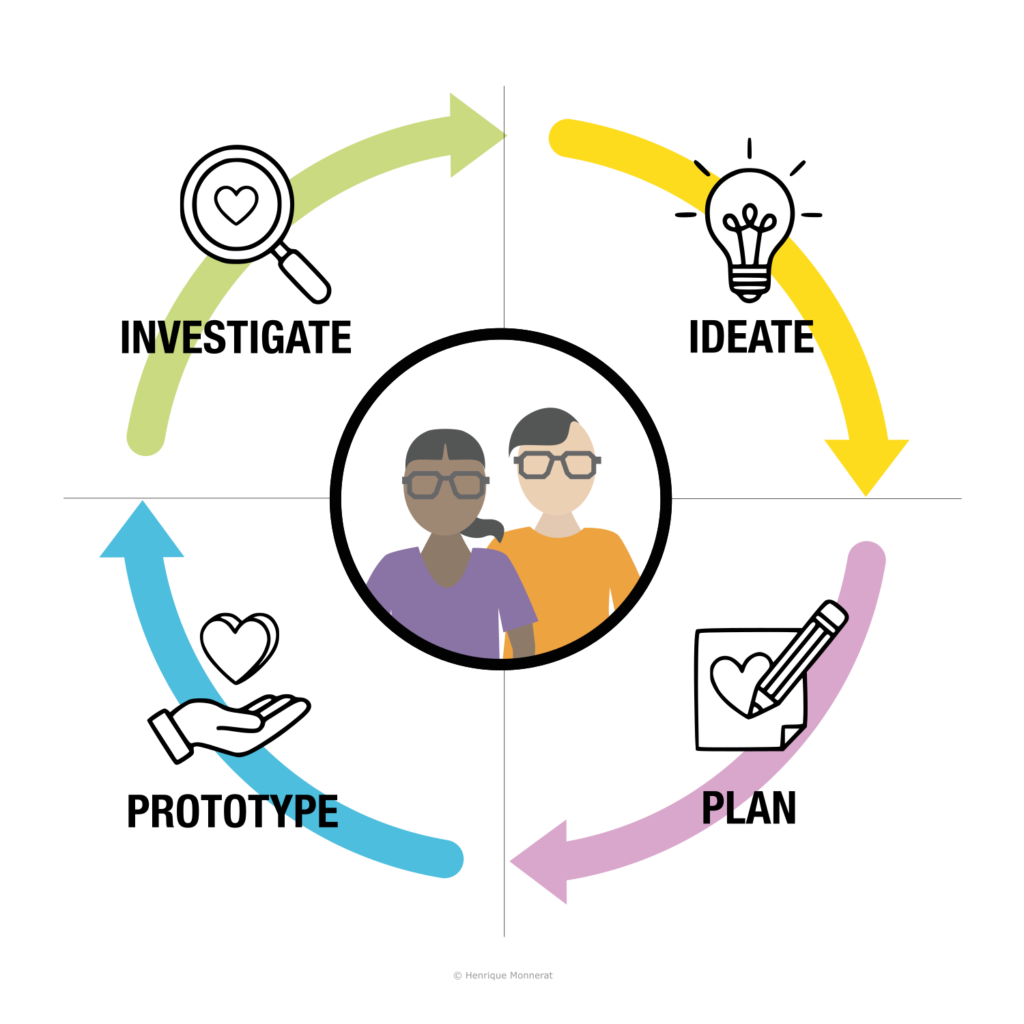
The Four Stages at a Glance
Investigate — Students research the problem before attempting to solve it. They explore the context through interviews, observation, and data, then synthesize their findings into a clear problem statement.
Ideate — Students generate many possibilities before committing to one. This stage emphasizes divergent thinking—quantity before quality, wild ideas before practical ones.
Plan — Students articulate and justify their solution before building it. They create sketches, list materials, and pitch their plan for feedback. This is where thinking becomes visible.
Prototype — Students build something real, test it, and learn from what happens. The goal isn’t a perfect product—it’s a prototype that teaches.
For detailed guidance on each stage, including student outputs and teacher planning questions, see The CDC Framework.
Why Use the Creative Design Cycle?
Most design frameworks tell students to “bias toward action”—jump from ideas to building immediately. That approach works for professionals with cheap materials and fast iteration cycles.
But in classrooms, immediate building creates problems:
- Wasted materials when students build without a clear direction
- Unfocused prototypes that don’t address the actual problem
- Missed learning opportunities because thinking happened silently
- Assessment challenges because teachers only see the final product, not the process
CDC’s Plan stage solves these problems. When students articulate what they’ll build and why before they start, teachers gain a window into student thinking. Misconceptions can be caught early. Resources are used intentionally. And the learning becomes visible.
How CDC Compares to Other Frameworks
| Other Frameworks | Creative Design Cycle |
|---|---|
| Designed for professional designers | Designed specifically for K-12 classrooms |
| Assumes rapid iteration with cheap materials | Acknowledges school constraints on time and resources |
| “Bias toward action”—build immediately | “Clarity before construction”—plan, then build |
| Assessment is often an afterthought | Assessment is built into each stage |
| Teachers must figure out facilitation | Teachers get explicit guidance and tools |
| Works best with self-directed adults | Scaffolded for diverse learners |
Who Is This For?
CDC works for any teacher who wants to bring creative, project-based learning into their classroom—whether you teach art, science, math, language arts, or technology.
You don’t need:
- Prior design experience
- Expensive materials or technology
- A dedicated makerspace
- Administrator approval to get started
You do need:
- 45 minutes of class time
- A willingness to try something structured but engaging
- Students who could benefit from thinking before building
Whether you’re a designer who wants to teach children or an educator with no prior knowledge of design, you can use the Creative Design Cycle to help students develop their creative abilities while meeting curriculum standards.
Who Created the Creative Design Cycle?

Henrique Monnerat
I’m a product designer turned educator with over 10 years of experience teaching design at university, graduate, and K-12 levels.
I currently teach technology at a school in Monterey, California. Every methodology in CDC has been tested with real students before being shared here.
I created the Creative Design Cycle because I saw students rushing to build without thinking, wasting materials on unfocused projects, and teachers struggling to assess creative work. CDC is my answer to those problems.
Background:
- Award-winning Product Designer
- 10+ Years Teaching Design
Frequently Asked Questions
How is CDC different from Design Thinking?
CDC is built on Design Thinking principles but adds the Plan stage—a dedicated space for students to articulate their solution before building. This addresses the specific challenges of classroom implementation: limited materials, time constraints, and the need to assess student thinking. For more on how design methods can help educators, read Structured Creativity: What Educators Can Learn from Designers.
What subjects can use CDC?
Any subject where students create something to demonstrate understanding. Science projects, writing assignments, art projects, math challenges, social studies presentations—CDC provides structure for any creative work.
What age groups does CDC work for?
CDC has been tested with students in grades 1-8. The framework scales—younger students may need more scaffolding and simpler Design Briefs, while older students can handle more complex challenges and deeper iteration.
Do I need special materials or technology?
No. CDC is tool-agnostic. Students can prototype with cardboard and tape, digital tools, writing, performance, or any medium that fits your context. The framework focuses on the thinking process, not specific materials.
How do I assess creative work with CDC?
CDC builds assessment into each stage. The Plan stage is especially valuable—when students articulate their thinking in writing or sketches, you have evidence to assess before they build. We provide rubrics focused on observable behaviors, not subjective “creativity.”
Can I try CDC in one class period?
Yes. The “Quick Experience” format compresses all four stages into 45-90 minutes. It’s the best way to experience the framework before committing to longer projects.
Why “Investigate” instead of “Empathize”?
Many design frameworks start with empathy—understanding users emotionally. CDC uses “Investigate” because it’s broader and more actionable for K-12 classrooms. Students research the problem through multiple methods: interviews, observation, data analysis, and yes, empathy. The word “investigate” signals rigor and aligns with inquiry-based learning standards.
Ready to Get Started?
Get the Free Lesson Kit—a scripted 45-minute lesson that walks you and your students through all four stages.